
Can a CTL Grader blade replace a Motor Grader?
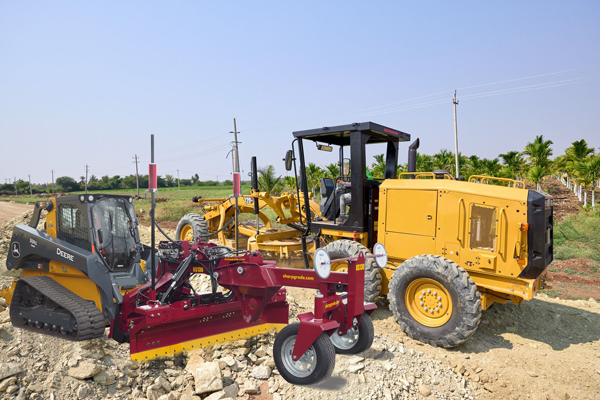
For decades, motor graders have been the undisputed choice for precision grading on construction sites, road projects, and large-scale landscaping works. Their long wheelbase, articulated frame, and centrally mounted moldboard have made them the benchmark for achieving accurate grades. However, advances in compact track loader (CTL) technology are challenging this traditional view.
Today's most powerful compact track loaders are pushing beyond 130 horsepower, placing them firmly within the power range of many smaller motor graders. At the same time, a new generation of grading attachments is delivering levels of capability that would have seemed unlikely just a few years ago.
The question is no longer whether a CTL can grade. The question is whether it can perform enough of a motor grader's work to become a viable alternative.
More Than Just a Grader Blade
Modern grading attachments have evolved far beyond simple box blades. Premium systems such as the SharpGrade GS130 now incorporate features traditionally associated with dedicated grading equipment, including hydraulic tilt, pitch adjustment, and side shift capabilities.
These functions allow operators to cut drainage swales, create cross-fall, maintain road crowns, and perform finish grading tasks with a degree of precision that was previously difficult to achieve with compact equipment.
Some systems also offer a removable front wheel assembly, transforming the attachment from a precision grading tool into a six-way dozer blade. This dual-purpose capability allows contractors to move from bulk material spreading to final trimming without changing machines or attachments.
The Transport Advantage
One of the biggest challenges facing motor grader owners is transportation.
Moving a grader between sites often requires a dedicated low-loader and can involve significant transport costs, permits, and logistical planning. In contrast, a CTL and grader attachment can often be transported on equipment already used by many contractors.
This reduces mobilisation costs and allows contractors to respond quickly to smaller projects where a dedicated grader would be difficult to justify economically.
For contractors working across multiple small-to-medium sites, this flexibility can have a significant impact on profitability.
Technology Changes Everything
Historically, grading was as much an art as a science. Skilled grader operators could take years to develop the experience needed to consistently achieve quality results.
Machine control technology has dramatically changed that equation.
Modern CTL grading systems can integrate with leading 2D and 3D machine control platforms, allowing operators to work directly from digital site models. The machine continuously monitors blade position and grade requirements, reducing reliance on operator judgement alone.
As a result, the learning curve for achieving accurate results is often substantially shorter than with traditional grading methods. Contractors can train operators more quickly, improve consistency between crews, and reduce costly rework.
Where Motor Graders Still Win
Despite these advances, motor graders are not becoming obsolete.
On large-scale road construction projects, extensive haul roads, and long-distance maintenance operations, dedicated graders still offer clear advantages. Their longer wheelbase, superior visibility, and ability to maintain high productivity over extended distances make them difficult to replace.
When projects involve grading kilometres of roadway every day, the efficiency of a dedicated motor grader remains hard to beat.
The New Reality
The real story is not that compact track loaders are replacing motor graders. Rather, they are expanding the range of projects that can be completed without one.
For many contractors, municipalities, landscapers, and civil construction businesses, modern high-horsepower CTLs equipped with advanced grading attachments now provide a practical and cost-effective alternative for a substantial portion of grading work.
With horsepower continuing to increase, attachments becoming more sophisticated, and 3D machine control technology becoming increasingly accessible, the gap between compact grading systems and traditional motor graders continues to narrow.
The result is a new generation of grading solutions that deliver precision, versatility, and lower ownership costs in a package that is easier to transport, easier to operate, and increasingly capable of taking on work once reserved exclusively for dedicated graders.